Bazu Score · Glucose
How Bazu draws your glucose curve
Predicted from the food itself. No monitor, no finger pricks.
Your day
Watch a day come together, meal by meal
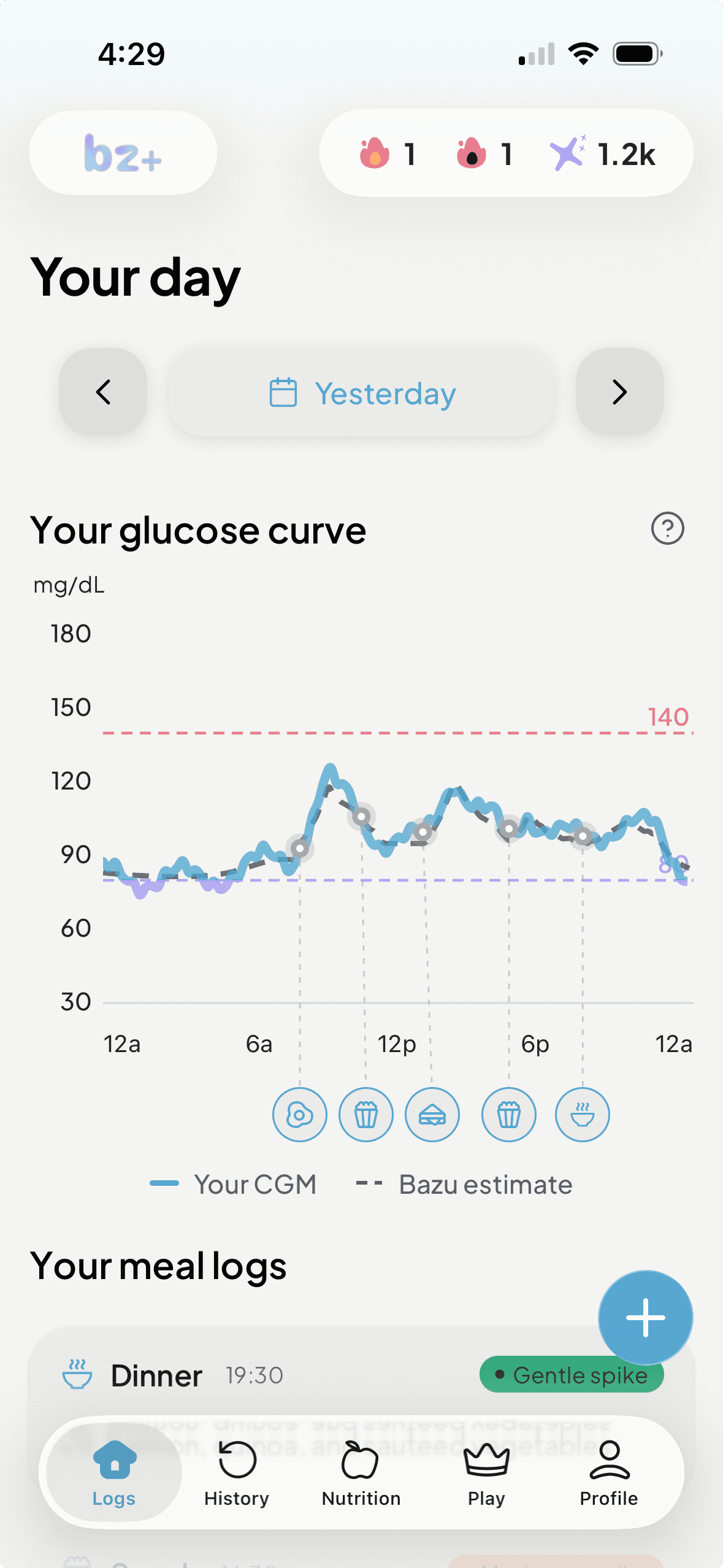
Log a meal and a piece of your curve appears. Five meals later, the whole day is drawn.
Your Bazu estimated glucose curve
mg/dL
Estimate based on your meals. Not a medical reading.
Your meal logs
What it is
A full day of blood sugar, shaped by your food
Bazu draws a 24-hour line of how blood sugar likely rises and settles, predicted from the meals you log and the body's natural daily rhythm.
What shapes the curve

Your meals
Each meal adds a peak. Faster carbs and bigger portions push it higher. Fiber, fat, and protein blunt it.

Time of day
Your body has a natural rhythm: lowest around 3am, a small rise at dawn, then a steady plateau through the day.

Your basics
Age nudges the baseline up a little after 60. We don't model exercise, stress, sleep, or medications yet.
How it works
From one meal to your whole day
Three steps, in the order the app does them.
Every meal gets its own curve
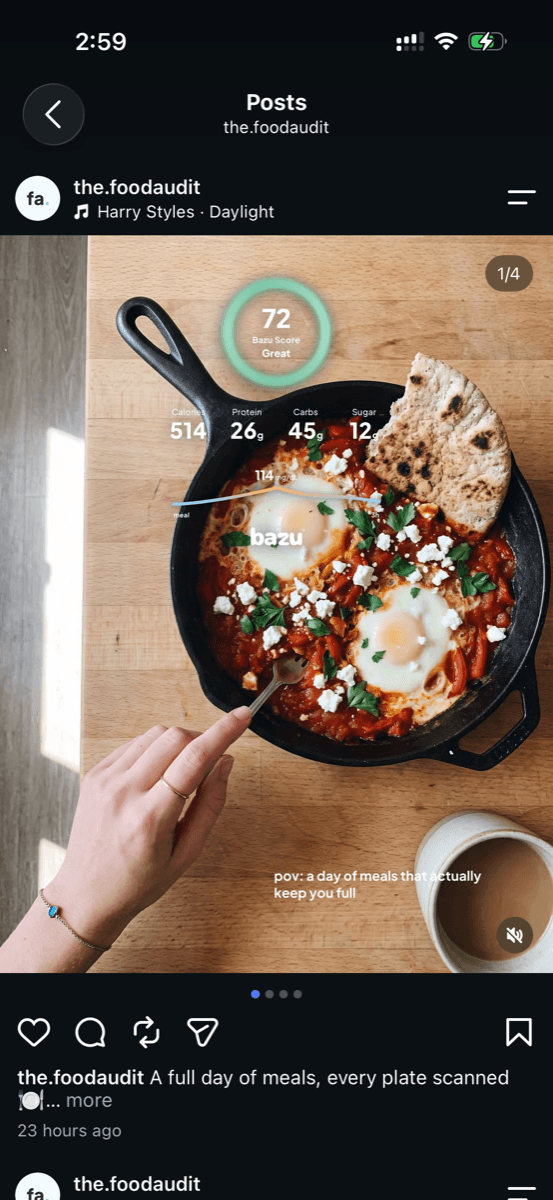
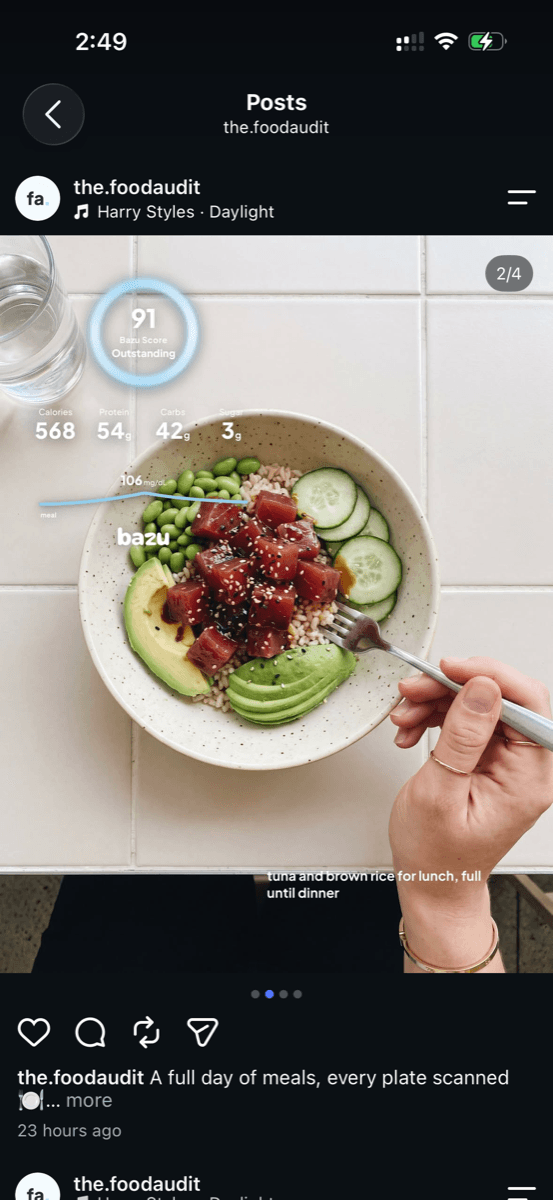
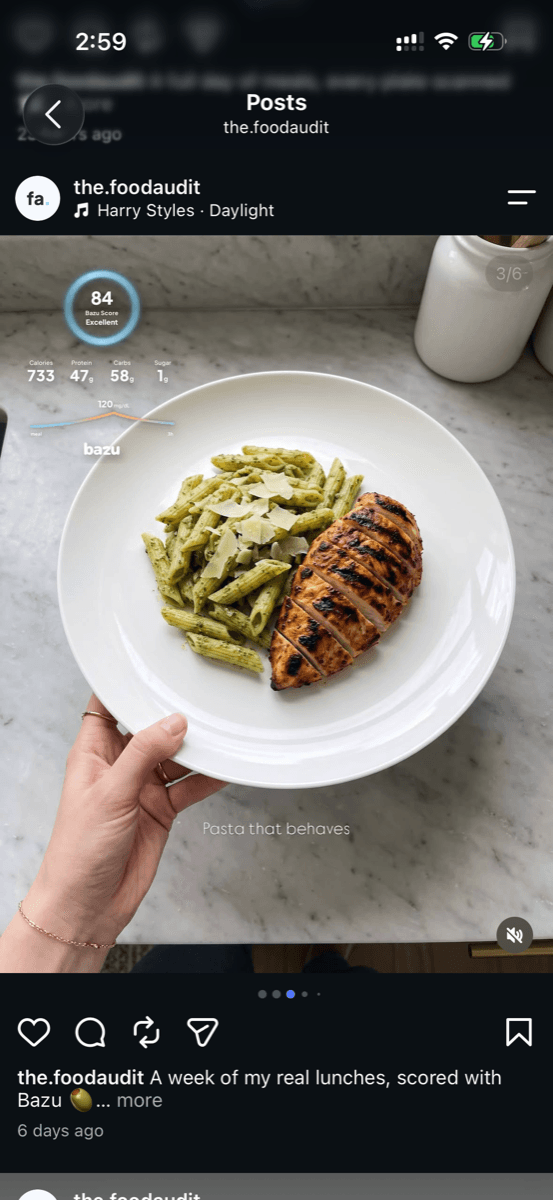
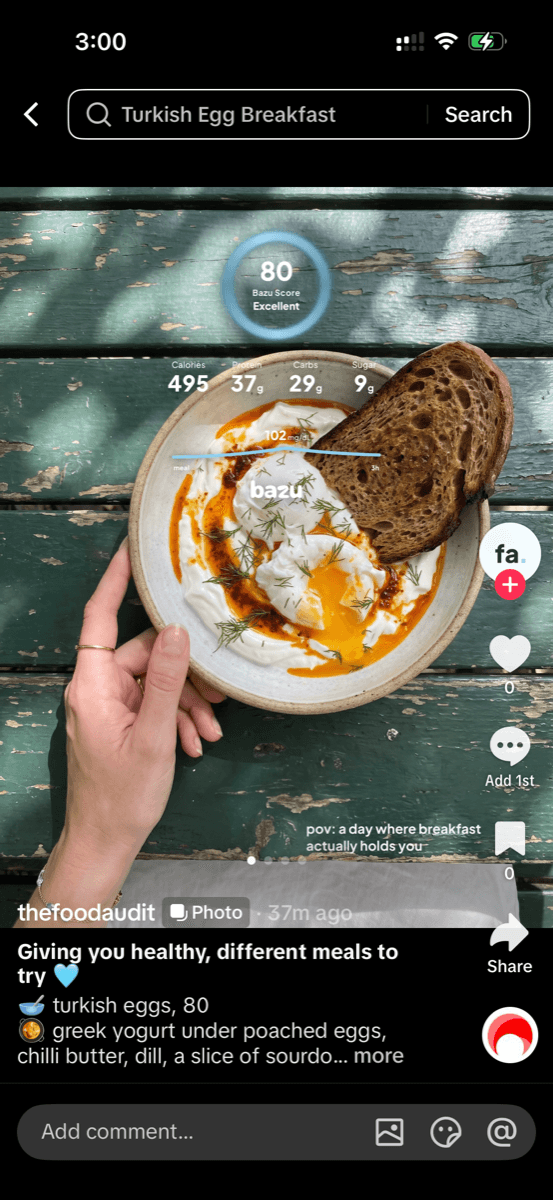
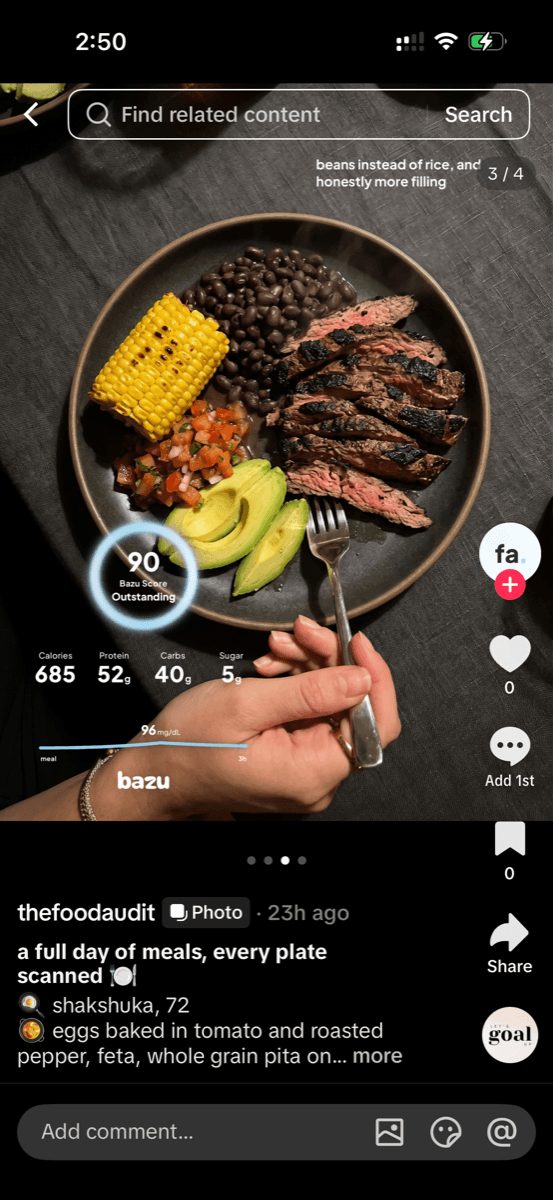
Log a plate and Bazu draws a fresh 3-hour curve for it, shaped by exactly what was on it. Wear a CGM and log the same meal a few times, and your real average response is drawn beside the estimate. The more you log, the more it reflects you, not just a typical plate.
Your average is built from your CGM over time, a trend, not a single reading.
Bazu's estimate vs your real curve
Every curve gets a verdict
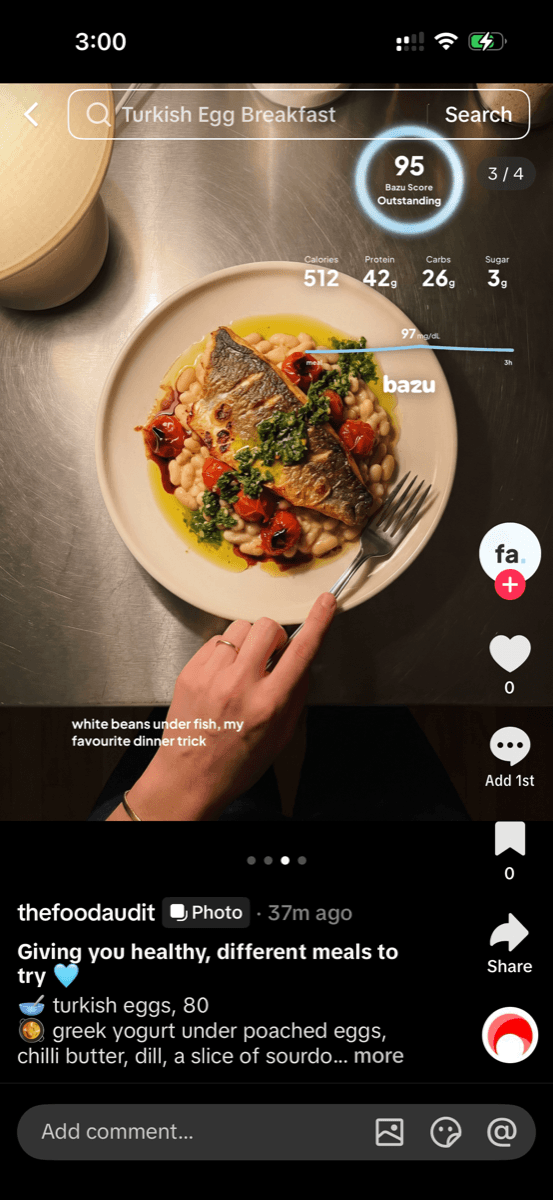
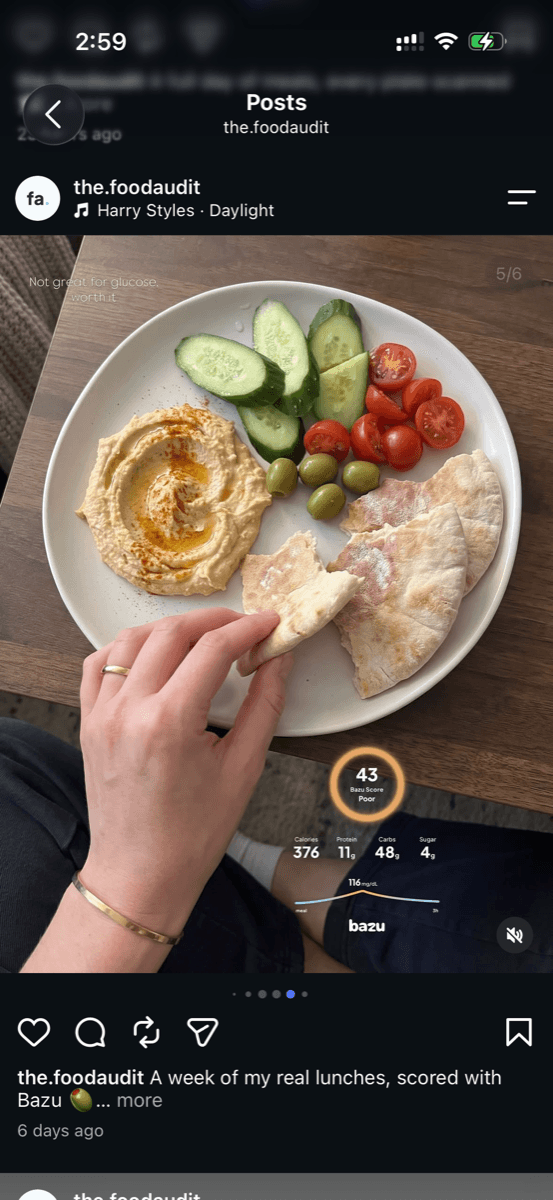
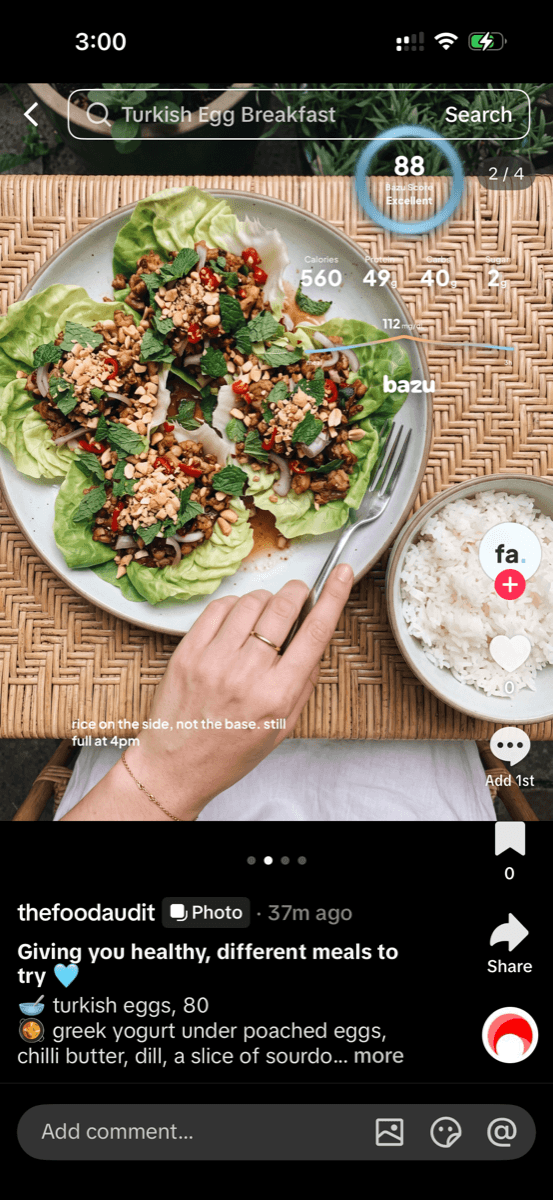
That curve lands in one of five zones, from no spike to very spiky. The zone is what you see on the meal, and it is the glucose piece of your Bazu Score, 25 of every 100 points.
No spike
Barely any carbs. Nothing here to spike.
100 points
Gentle
A gentle rise. Its carbs land softly.
80 to 99 points
Medium
A moderate rise. Steady, not scary.
60 to 79 points
Spiky
A real spike from its carb load.
40 to 59 points
Very spiky
A big, fast spike.
0 to 39 points
Protein and fiber soften a load. Fat does not. Your last 30 days of meals average into the glucose piece, and that piece is 25 of your Bazu Score.
How the Bazu Score worksEvery meal joins your day
Each meal's peak is laid on the body's baseline rhythm, in order, without stacking into spikes that could never happen. Solid where a meal shapes the line, dotted on the baseline, shaded for how sure we are. That is your day.
An estimate from your meals. Not a medical reading.
With a monitor
Got a CGM? You see the real thing.
Connect a CGM and the line becomes real, every point a sensor reading. We show the Bazu estimate right beside it, dashed, so you can see how closely the prediction tracks. Gaps appear when the sensor drops out. We never invent data.
Without a monitor
No monitor? We estimate it from your food.
No sensor, no finger pricks. Bazu builds your day from the meals you log, a typical response, not yours, the shape and trend of your day rather than exact numbers.
A baseline rhythm
We start with a 24-hour curve from glucose research: low overnight, a small rise at dawn, a steady daytime plateau.
Each meal, read
We look at what shapes a peak in what you logged:
Each meal, predicted
Those numbers go into a published formula that works out how fast the carbs digest, then get bounded by measured ranges for that kind of food. Nothing is guessed at by an AI. That becomes a peak on the line: how high it climbs, how fast it gets there, how long it lingers.
Laid on your day
Meals sit on the baseline without stacking into impossible spikes. Solid where a meal shapes the line, dotted on the baseline, with a shaded band for how sure we are.
Who it's for
Who it's for, and who it's not

For you if…
You're healthy and glucose-conscious, and you want to see how food moves blood sugar, no monitor, no finger pricks.

Not for managing diabetes
If you have Type 1, Bazu turns the estimate off and shows a real CGM only, never a prediction. With pre-diabetes or Type 2, your real numbers likely run higher than our non-diabetic baseline.
Bazu is a general wellness tool. Not a medical device, not medical advice.

Backed by research
Built on real science, not a guess
The baseline comes from 24-hour glucose studies in non-diabetic adults. Each meal's curve, how high it rises and whether it dips or lingers, is modeled on a database of more than 1,000 foods measured in healthy people. The things Bazu helps you notice come from published research too.
A blood-sugar dip after a meal is linked to feeling hungry sooner.
A short walk after eating noticeably flattens the rise.
Eating veggies and protein before carbs lowers that meal's rise.
Diets high on the glycemic index are linked to higher heart-disease risk, even without diabetes.
Curve shapes from Brand-Miller 2009 (AJCN, 1,000+ foods). Baseline from Freckmann 2007, Bolli & Gerich 1984, and Shah 2019. Findings are framed as associations, not medical claims.
FAQ
Common questions
See the glucose curve, free
Scan any food, log your day, watch the curve come together